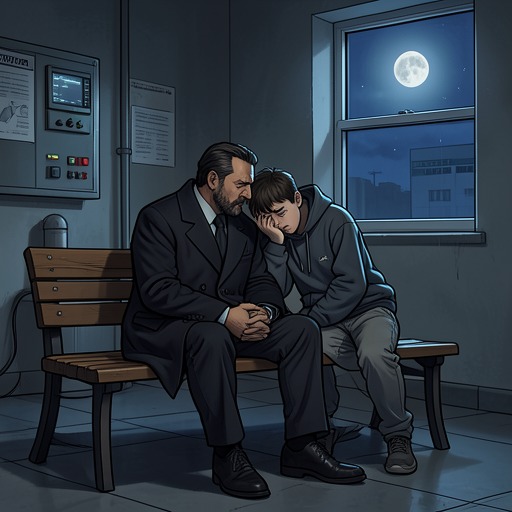
Simon’s recurring suicidal crises and psychological distress
This Is Going to HurtSimon’s recurring suicidal crises and psychological distress are revealed through a relationship that begins with one late-night intervention and continues for years. Adam Kay, a doctor who initially knows Simon only as a school friend’s younger brother, becomes an informal source of support after seeing a worrying Facebook post. Their repeated conversations bring Simon reassurance and connection, but also expose the strain and limits of Kay’s role: he urges Simon to keep seeing his GP, worries over missed calls, and eventually has to understand progress not as a simple cure but as learning to manage distress.
The first intervention
On Monday, 3 April 2006, during an unusually quiet night shift, Kay is browsing Facebook at about two in the morning when Simon’s post signals that he may be in danger. Kay thinks he could be the only person seeing it at that hour. Although the two are not close, he sends Simon a private message, asks whether he is all right, says he is awake, identifies himself as a doctor, and gives Simon his mobile number. The immediacy of the response matters: Kay does not wait for certainty or for a formal request for help before making himself reachable.
Simon calls, drunk and crying, after separating from his girlfriend. Kay acknowledges that he has little training in this area; his knowledge of how to respond is no greater, he jokes, than his knowledge of laying bathroom tiles. What makes the conversation possible is not specialist expertise but Simon’s willingness to trust him. They talk for two hours. Simon agrees to take a taxi to his mother’s house and see his GP the next morning. When the call ends, Kay feels the surge of relief and purpose he associates with a medical emergency, and believes he may have helped Simon more than he helped any patient during that shift. The encounter establishes both the value and the ambiguity of his involvement: a personal conversation has helped secure an immediate next step, but it has not made Kay a mental-health specialist.
An informal helpline over time
By Saturday, 7 October 2006, the first exchange has become a pattern lasting six months. Kay has told Simon that he can call whenever he starts to worry, and Simon does call. Kay repeatedly encourages him to continue seeing his GP, but observes that Simon does not seem to take that advice in. The arrangement therefore contains two different kinds of support: a professional route that Kay recommends, and the direct, personal availability that Simon actually uses.
The open-endedness takes a toll on Kay. He does not know when the next call will bring bad news, and the uncertainty feels too much like the demands of work. He thinks Simon could receive better help from someone more qualified, while admitting that he has had to search online for guidance on what to say to a person who may be suicidal. Even so, Kay believes that talking to him is better than having no one to talk to, and is glad Simon is still alive. A missed call can trigger panic: Kay wonders whether returning it too late might mean Simon has died, and whether that would make the outcome his fault. The fear shows how a promise of constant availability can turn into a sense of personal responsibility for events Kay cannot control.
That evening, they have another conversation. Kay listens and reassures Simon that his feelings will pass. The conversation seems much like those they have had before, but Kay recognizes that repetition does not necessarily make it useless. Simon wants to know that someone cares, and Kay understands that this kind of attention can be part of being a doctor. The account does not suggest that reassurance resolves Simon’s distress; rather, it presents continued contact itself as something he seeks and receives.
Repeated calls and uncertainty
The pattern continues into the following year. On 2 October 2007, after a very long day on the labour ward, Kay retrieves his phone from his locker and finds seven missed calls from Simon and several voicemails. He can hardly bear to listen, fearing that the messages may mean he has already been too late. The explanation is mundane: Simon has sat on his phone. The incident ends the immediate fear, but it also makes visible how quickly an ordinary missed-call notification can become a crisis for Kay after months of uncertainty.
The episode briefly shifts the balance between Simon’s distress and Kay’s interpretation of it. The calls appear to announce an emergency, yet no emergency has occurred. Kay’s relief is accompanied by exasperation, but the false alarm does not undo the underlying pattern: he remains alert to the possibility that the next call may be different. In the account, Simon’s recurring distress is therefore shown not only through acute events but through the waiting they create in someone who has agreed to be available.
The 2009 crisis and a changed measure of progress
On Sunday, 8 February 2009, Simon calls Kay to say that after a fight with his new girlfriend the previous night, he had seriously harmed himself and ended up in hospital. By the time he speaks to Kay, he is back at home and says he is feeling all right. Simon asks whether Kay is angry with him. Kay tells him he is not, although privately he is angry that Simon did not call before the crisis, so that Kay might have tried to calm him. He feels Simon should have given him that chance, then feels guilty for being angry. Concern and resentment coexist, and neither cancels the other.
They talk for about an hour. Kay again tells Simon that he can call at any time, day or night. They have had the same conversation many times over the preceding years, and Kay is saddened that Simon’s situation seems no better than when the first Facebook post appeared. But he questions whether improvement should be measured by comparing emotional distress to a broken leg that can simply be fixed. Simon’s feelings are not easy to cure; what Kay can see is that Simon is learning how to manage them. Kay concludes that it matters that nothing worse has happened in the interval, even if the crisis has not disappeared.
Care, limits, and responsibility
Across these encounters, Simon’s psychological distress is described through observable changes and repeated contact rather than through a diagnosis or a complete account of his inner life. The narrative records the breakup behind the first call, the later relationship conflict, his calls and missed calls, his hospital visit, and his wish to know whether Kay is angry. It does not claim that Kay’s support cures him. Instead, it shows a continuing relationship in which listening and reassurance help, while professional care remains an important recommendation that Simon does not consistently follow.
Kay’s position is deliberately unsettled. He is a doctor, but he admits his limited preparation for this particular kind of crisis; he offers his number and repeated access, but cannot guarantee that he will prevent harm. His worry about whether a late callback would make him responsible sits beside his recognition that Simon’s feelings cannot be fixed on demand. The movement from the first emergency-like conversation to the later, more qualified understanding of management gives the account its central change: success is no longer imagined only as making the distress disappear. It also means that Simon remains connected, learns ways to manage his feelings, and gets through periods when Kay fears the worst.